
Shroom Dharma
Or dosing on retreats...

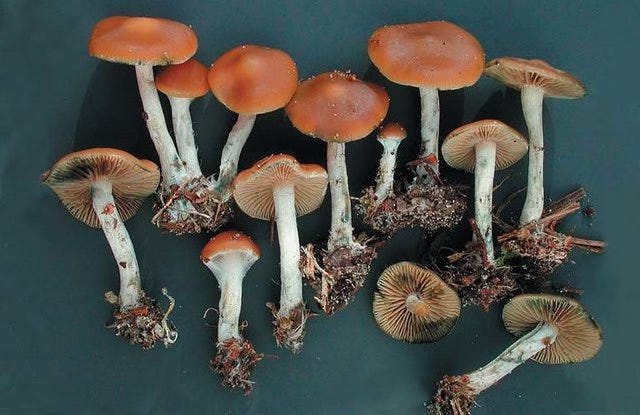
Many Western Buddhists, especially the Baby Boomers, found their way to Buddhism via psychedelic drugs. It is alleged that that some Tibetan Buddhist teachers, such as Chogyam Trungpa, experimented with LSD with his students. But most of these people grew tired of the plastic spirituality that came along with the psychedelic experience, and moved on. Trungpa himself is said to have characterized LSD as “double samsara.”
In my younger years— a teenager in the 1970’s in an environment were drug use was lionized by Ken Kesey, Hunter Thompson, and so on, and people were sucked into the fantasy novel posing as a ethnographic treatise, The Teachings of Don Juan by Castaneda—I did many different kinds of psychedelics, but after the novelty wore off, I came to find them boring, repetitive and of no value. Since I am “experienced,” I can say for certain that entheogens are of no value for Buddhist practice, despite whatever people may claim to the contrary. Having also met Buddhism during the same period, I am quite certain that my experimentation with various drugs did not contribute at all to my Budddhist path, which could be said to have begun in 1978, when I was 16. One thing I can tell you is that I never hallucinated even once—bummer, man. But I saw lots of pretty patterns in ordinary things, and so on.
Enter the Tech Bro generation. These days it is quite common to see advertisements for Buddhist retreats where microdosing is part of the package. We see articles on tripping in “respectable” Buddhist establishment magazines such as Lion’s Roar and Tricycle. There are is a Center for Psychedelic Studies at Naropa, which offers certificates in Psychedelic-Assisted Therapies, Psilocybin Facilitator Training, the Psychedelic Alchemy Speaker Series, as well a minor in Psychedelic Studies. A quick Google search leads one to Ayahuasca retreats that combine Buddhist practice, and Buddhist retreats combining Iboga, and so on.
While there is certainly considerable therapeutic interest in entheogen use for PTSD, preparation for death in hospice situations, and so on, such applications in a Buddhist retreat context are extremely questionable and ill-advised. Breathless reviews of the benefits of psychedelics are all over the place these days, and most are just uncritical assertions about their benefits. Microdosing may be not be “double samsara,” but it is definitely an enhancement of samsara. I’ve run into people who gleefully microdose on LSD at various teachings, who, like all drug aficionados, want companions with whom to, in the word of Leary, “Turn on, tune in, and drop out.”
My teacher, Chogyal Namkhai Norbu, used to talk about people who would make a “Milanese Stew” of the teachings, just throwing together a bunch of ingredients in a pot and cooking it until one could not tell one thing from another. Entheogen use in combination with Buddhist practice is just this kind of thing.
Buddhism in India, Tibet, and so on, does not have a tradition of entheogen use at all. There has never been a time in history where the use of mind-altering drugs is advocated in Buddhism, apart from a single passage in a text that recommends datura—a very strong and dangerous drug that induces severe hallucinations—for people who have very stubborn clinging to things being real and permanent. In Buddhist texts, the effects of datura are mentioned over and over again as an example of total delusion. In apotropaic Buddhist rites datura is used primarily as a substance for inducing terror in enemies. Thus, so-called “Buddhist teachers” who encourage such practices during their retreats are doing a disservice to their students.
It may be objected that indigenous traditions utilize various kinds of drugs to induce religious experience, and that these traditions should be respected as a part of human culture in all its diversity, and I agree. However, all these traditions are worldly traditions of no spiritual value to Buddhists. At worst, the drugs they promote, like Ayahuasca, can be very harmful and ruinous, and their promoters, unethical scoundrals. Any one who has read Singing to the Plants will swiftly understand that the motivations and world view of these indigenous practitioners do not align themselves with bodhicitta, ahimsa, and all the other values we Buddhists hold.
There is a small, but growing subset of people seeking to combine the sublime tradition of the Buddha with use of psychedelics, such as we see at Naropa, primarily to make money as “healers.” But what do they propose to be healing? For something to be medicine, there must be a disease to remedy. What disease do these folks propose to diagnose and treat? I think that we should be very suspicious of the whole project, especially when it comes to combining entheogen use with mindfulness, etc.
Frankly, this trend of combining psychedelics with Buddhist practice is corrupt and wrong. Buddhists who care about the dharma should speak out against such contamination and should avoid teachers who recommend entheogen use—whether micro or macrodosing—during their retreats.
LSD and DMT have helped me to learn about the functions of mind and its delusional character in the seventies, sometimes very shocking and amazing at the the same time; I started reading dharma literature available at the time, which have connected me to the teachings, didn`t understand much of it .. but am still grateful to those early mind-experiences I must say ..
I really appreciate hearing this. Opinions on this topic vary so widely. People have clearly got such a wide range of conditions and experiences. Just as it's easy to justify our mental habits because they are ours, and they are habits, and because we each see the world from our unique points of view, an individual participates in this discussion from a certain point of view. I understand Buddhist practice not to be aimed at solidifying or justifying a point of view but at continually working with one's klesas, observing and finding the roots of our ignorance, and so on. So, since I am not someone who has taken drugs, it's impossible for me to say what their value is to someone else. That being said, what I observe is a need to justify or negate something. I have this too. And I can observe that need. An old friend in the sangha has told me that he would never have encountered the teachings without LSD experiences in his youth. He does not know for certain that this is true, nor do I. I would probably never have encountered them if I had taken drugs but I don't know if this is true or not. The proof is in the pudding. And I am definitely a pudding.