
Vibe Buddhism
It's all so Zen

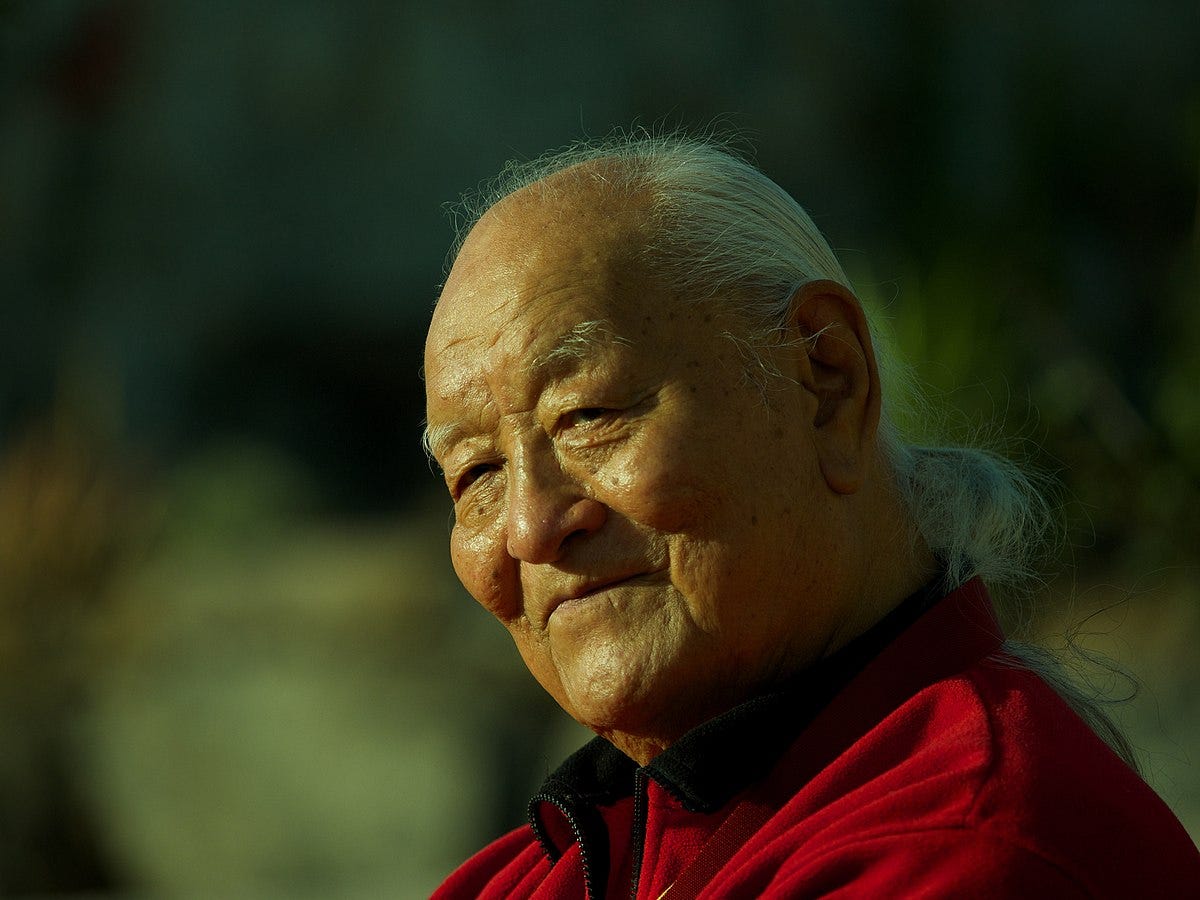
Chogyal Namkhai Norbu told a story of a person at one of his retreats, who, with great sincerity, told him that she liked his explanations very much, but that he did not really give off the kind of vibration she was seeking. His reply? “I am sorry I couldn’t give you any vibration.”
Vibe Buddhism has been around a long time, and among white Americans, even longer than authentic Buddhism. Arguably, Vibe Buddhism begins with Jack Kerouac’s 1958 novel, The Dharma Bums. While there were other writers out there, like Alan Watts, Paul Reps, and so on, who contributed to the overall Beat Zen period of American Buddhist history, Kerouac’s immortalization of Gary Snyder as Japhy Ryder inflamed a whole generation of hippies’ interest in Buddhism. More importantly, framed Buddhism as hip and cool.
Vibe Buddhism never faded after the 1960s. It became mainstream. A quiet trip down memory lane reveals the word “Zen” has become common parlance for everything from austere simplicity in design to faux profundity. There are thousands of books with the word “Zen” in the title, the vast majority of which have nothing to do with Zen.
Another relic of Vibe Buddhism is Tibetan “Singing” Bowls, which are neither Tibetan, nor do they sing. They are a type of metal bowl discovered in Kathmandu by hippies in the 1960’s, which make an attractive vibrating sound when the rim is rubbed with a stick. Mistaken for the type of gongs commonly found in Chinese and Japanese temples, they are now ubiquitous among sound healers, new age therapists, and so on. Singing bowls are used for cakra tuning, third eye opening, and even communicating with aliens. Now, of course, you can find them etched with mantras like Oṃ maṇi padme hūṃ, but when I first encountered them in 1984, such bowls did not exist.
Malas too are all the rage these days. There are endless downbeat tracks entitled Buddha this, Buddha that, Zen this, Zen that, etc. Buddha statues are centerpieces in dance clubs. Mandalas are printed on t-shirts. Mantras and yidams are indiscriminately tattooed on the body.
Mindfulness, as described in Purser’s McMindfulness, has been completely taken over by corporate America as a neoliberal strategy to offload the stress of the person-cum-commodity in today’s market onto the commodity itself.
Mindfulness app culture is completely imbued with Vibe Buddhism. Sam Harris, noted atheist and physicalist, now markets Buddhist teachers on his Waking Up app, which he describes as a new “operating system” for the mind. He promises one will “discover the true purpose of meditation,” “understand why you are practicing,” and “live an examined fulfilling life.” The list of teachers he sells on his app is a smorgasbord of representatives from Vipassana, Zen, Tibetan Buddhism, and Neo-Advaita, all neatly packaged for the “serious seeker” who is seeking to avoid “new age fluff,” “tested by modern science.” Of course, it is all just marketing puffery. I won’t accuse Harris of commodifying the Dharma, as that has been going on for centuries. But it is stupid for anyone to pay $125 a year to learn anapanasati, mindfulness of breathing.
It is quite incredible to see the number of Western teachers of Buddhism, male and female, who claim as a credential “former Buddhist monastic.” Particularly in the Tibetan tradition, to be a “former monastic” is to admit failure. But somehow, westerners have decided it is a credential which lends them authenticity. Headspace, for example, was founded in 2010 by a “former Buddhist monk,” Andy Puddicombe, who claims to be a mediation and mindfulness expert. It is unclear if he ever learned Tibetan, and his description of his career makes it sound as if he spent 1994-2004 collecting techniques, which he and his partner monetized into a very successful business. But a meditation expert? How can anyone trained in the Buddhist tradition claim to be a meditation expert if they have not experienced even a glimmer of the awakening the Buddha pointed out? At the very least, they should have experienced heat on the path of application (prayogamarga) before calling themselves experts. And even then, who will authenticate their claim? Luckily. for him, he is an ex-monk, so the rule concerning bragging about spiritual attainments does not apply. Caveat emptor.
Many of us started with Vibe Buddhism, identifying with Buddhism before we really had even the simplest notion of what the Buddha’s Dharma entailed. However, suffering isn’t “Zen,” so many people who initially vibed on Buddhism moved on. Those of us who remain with the Dharma understood that the reason why we vibed with Buddhism is that it spoke to us on an existential level, one that found no solution in theistic religions, philosophy, or other intellectual games.
Like the Buddha, we learned that meditation does not solve anything—without wisdom, prajñā, meditation is a dead end. We also learned that the Dharma is not a collection of meditation techniques to reduce stress nor address mental health issues (as is dubiously claimed), nor a theme for interior decoration, nor a source of titles to be used for vapid electronic music and novels, nor a social scene to find friends.
So, if you are looking for vibrations, it is unlikely that the sublime Dharma is for you. It’s better to listen to the Beach Boys.
"Many of us started with Vibe Buddhism, identifying with Buddhism before we really had even the simplest notion of what the Buddha’s Dharma entailed"- totally, I too was inspired by Japhy Ryder. In my 20's i was in a halfway house in Houston run by this tuff ex hooker. She was interviewing me and asked me if I had any religious beliefs. I said I think im Buddhist. She took a drag off her cigarette, exhaled, looked at me coldly and said "you dont know shit about Buddhism" 🤣
Well said. Most people that I've met who are interested in mindfulness or Buddhism are not interested in liberation and feel like such a thing is foolish/impossible. Count me among the fools, then.